Collated Nails Explained: Types, Applications, Manufacturing Process, and Buying Guide
What Are Collated Nails?
Collated nails are individual nails joined together with plastic, paper, or wire strips. They are specifically designed for use with automatic or pneumatic nail guns.
Compared with loose nails, collated nails offer:
- Faster installation
- Higher productivity
- Consistent nail spacing
- Reduced manual handling
- Improved workplace safety
These advantages make them popular in both construction sites and manufacturing facilities.

Common Types of Collated Nails
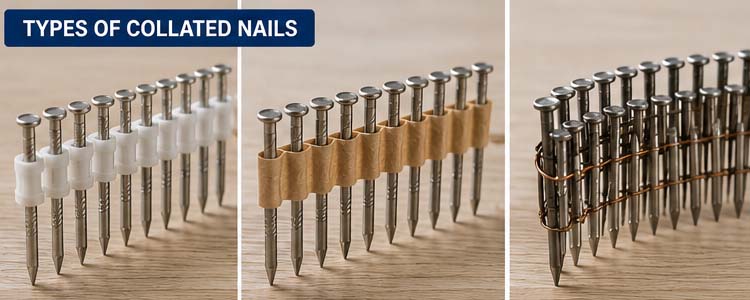
Plastic Collated Nails
Plastic collated nails are connected with durable plastic strips.
Advantages include:
- Strong strip stability
- Suitable for framing nailers
- Reliable feeding performance
Typical applications:
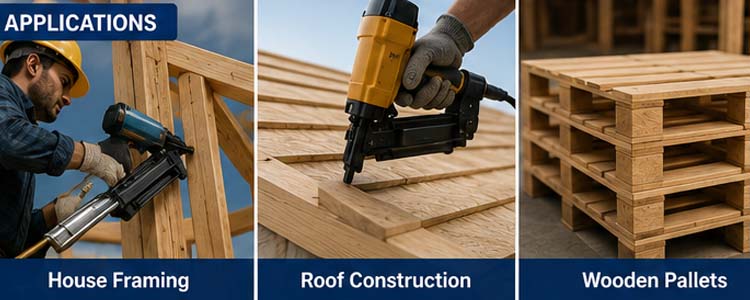
- House framing
- Timber construction
- Wood packaging
Paper Collated Nails
Paper collated nails are held together by heavy-duty paper strips.
Benefits include:
- Less job-site debris
- Smooth feeding
- Improved environmental performance
Common uses:
- Residential construction
- Roofing
- Interior framing
Wire Collated Nails
Wire collated nails are connected with thin steel wires.
Advantages:
- High durability
- Excellent feeding reliability
- Suitable for heavy-duty applications
Applications:
- Pallet manufacturing
- Crate assembly
- Industrial packaging
Common Materials
Collated nails are commonly manufactured from:
Low Carbon Steel
- Good ductility
- Economical
- Suitable for general construction
High Carbon Steel
- Higher hardness
- Heavy-duty fastening
- Industrial applications
Galvanized Steel
- Corrosion resistance
- Outdoor construction
- Coastal environments
Manufacturing Process
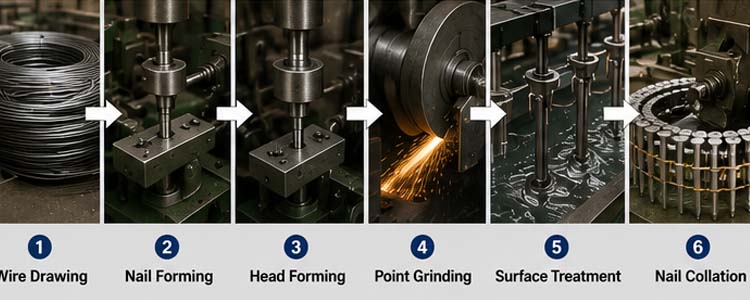
Modern collated nail production includes:
- Steel wire preparation
- Wire drawing
- Nail forming
- Head forming
- Point grinding
- Surface treatment
- Nail collation
- Quality inspection
- Packaging
Advanced automatic nail making machines ensure accurate nail dimensions before the collation process.
Quality Inspection
Reliable collated nails should be inspected for:
- Nail length
- Diameter
- Head consistency
- Strip strength
- Feeding performance
- Surface coating
- Packaging integrity
Strict inspection reduces tool jams and improves installation efficiency.
Applications
Collated nails are widely used in:
- House framing
- Roof construction
- Wooden pallets
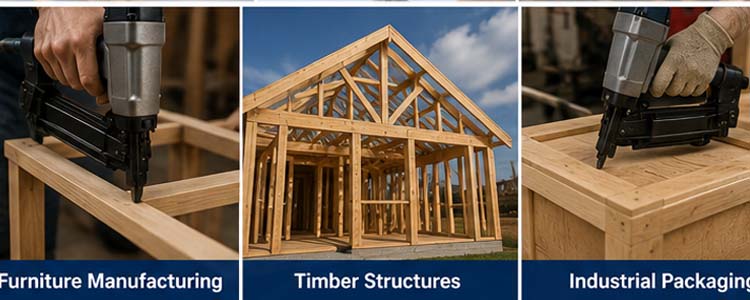
- Furniture manufacturing
- Timber structures
- Packaging
- Prefabricated buildings
- Industrial woodworking
How to Choose the Right Collated Nails
Before purchasing, consider:
- Nail gun compatibility
- Material type
- Corrosion resistance
- Nail length
- Shank design
- Application environment
Selecting the appropriate collated nail improves fastening quality and extends tool life.

Frequently Asked Questions
What are collated nails used for?
They are primarily used with pneumatic nail guns in construction, woodworking, and pallet manufacturing.
Are collated nails available in galvanized versions?
Yes. Electro galvanized and hot-dip galvanized collated nails are widely available for outdoor use.
Which collated strip is best?
The choice depends on the nail gun and application. Plastic, paper, and wire collations each have their own advantages.
Can automatic nail making machines produce collated nails?
Yes. Modern production lines combine nail manufacturing with automatic collation equipment.
Are collated nails stronger than loose nails?
The nail itself has similar strength. The advantage lies in faster installation and more efficient handling.